
Nature as an Asset Class
The $23.5 Billion Opportunity Corporate Finance Is Still Missing
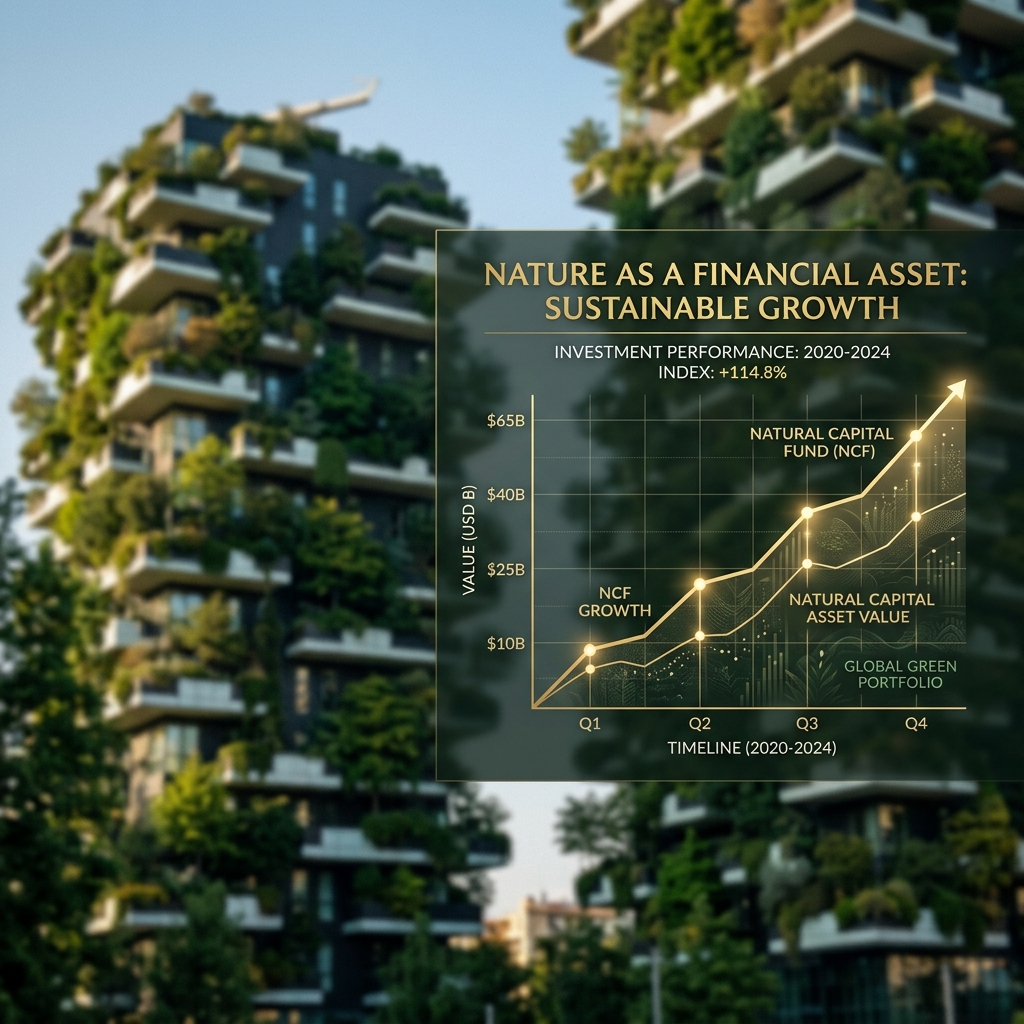
In 2026, the voluntary carbon market is projected to be worth somewhere between $3 billion and $23.8 billion, depending on which analyst you ask. That range tells you everything you need to know about where we are with nature-based investment: a market that is enormous, growing fast, and still profoundly misunderstood by the corporate world that should be leading it.
Forest finance, specifically, represents a $23.5 billion annual opportunity. And the gap between what's flowing into it and what needs to flow into it — the so-called nature finance gap — is estimated at $340 to $467 billion per year. These are not abstract numbers from an environmental NGO's fundraising deck. These are the figures coming out of the World Resources Institute, UNEP, and the World Economic Forum. The markets know the opportunity exists. Most corporations just haven't figured out how to access it yet.
That's a problem — but it's also, for those who move now, an extraordinary opening.
Why the Narrative Is Finally Shifting: From Donation to Investment
For years, corporate engagement with forests looked like this: a press release, a tree-planting partnership with an NGO, a line item in the CSR report. Maybe a certificate. It was branding dressed as climate action. And the market rewarded it with mild applause and a footnote in an ESG rating.
2026 is different. The analytical infrastructure has matured enough that the investment case for nature is now being made in the language of finance, not environmentalism. A January 2026 analysis from Trellis put it bluntly: nature-based solutions will remain central to corporate climate strategies in 2026, but as investments, not reputational cover. Ratings agencies and ESG frameworks are beginning to reward NBS investments. The narrative is maturing — from saving trees to investing in forest economies.
The World Economic Forum, writing in March 2026, described natural capital as the next great frontier for climate investing. Pension funds, insurance companies, and global investment houses are finding that long-term investing in natural capital delivers capital preservation, real asset exposure as an inflation hedge, and measurable impact through carbon offsets and biodiversity credits. Some of the world's largest alternative asset managers are now treating forestry, farmland, and habitat restoration as serious portfolio components.
The Carbon Market Is Growing Up — And That's Good for Serious Investors
The voluntary carbon market has had a rough few years. There were scandals, inflated credits, greenwashing controversies, and a public reckoning over the integrity of some forest conservation schemes. All of that was real. And all of it is, in retrospect, part of a market that is maturing.
In 2026, the architecture of the voluntary carbon market is fundamentally stronger than it was even two years ago. Article 6.4 of the Paris Agreement — the UN-run carbon crediting mechanism — is expected to issue its first credits by the end of this year. The Integrity Council for the Voluntary Carbon Market (ICVCM) is revising its Core Carbon Principles to include clearer rules on reversals and risk buffers. The SBTi is expected to finalize its second version of the Net-Zero Standard in 2026, which will clarify the role of durable removals in offsetting residual emissions.
The Numbers That Make the Investment Case
Let's talk about the financial fundamentals that most corporate ESG teams still haven't fully internalized. Nature-based solutions deliver sequestration at roughly $24 per tonne. That's a 6x cost advantage over current technology like CCUS ($160/tonne), not counting the co-benefits.
UNEP calculates a $30 return per every $1 invested in ecosystem restoration. That's not a charity return. That's a financial return that most infrastructure assets would struggle to match.
Investors and platform companies are increasingly recognizing this. Mintz, a major law firm advising on natural capital transactions, noted in April 2026 that capital is now moving beyond pilot projects toward scalable platforms combining land restoration, long-term asset management, and carbon credit generation. Transactions are growing. Partnerships between energy investors and environmental asset managers are multiplying.
The Window Is Open — But Not Forever
Here's the honest opinion: companies that treat forest investment as a nice-to-have — a reputational sweetener for a fundamentally unchanged business — are going to find themselves structurally disadvantaged within three to five years. The regulatory environment is tightening globally. The EU Deforestation Regulation is creating mandatory due diligence requirements. Carbon pricing is spreading. And the supply of high-quality, verified nature-based credits is genuinely constrained.
The companies that move now — that build actual portfolios of verified nature-based investments, that structure their climate strategy around assets rather than announcements — will have a meaningful first-mover advantage in the most underpriced asset class of the 21st century.
Sources:
- Trellis: 'Nature-Based Solutions: 4 Predictions for 2026' (January 2026). trellis.net
- World Economic Forum: 'Why Natural Capital Is the Next Great Frontier for Climate Investing' (March 2026). weforum.org
- Mintz: 'Investor Signal: Capital Scaling in Nature-Based Carbon Platforms' (April 2026). mintz.com
- Carbon Credits: 'Voluntary Carbon Market in 2026: Top Forecasts' (December 2025). carboncredits.com
- World Resources Institute: Nature and Carbon Markets Initiative. wri.org
- UNEP State of Finance for Nature (2023 edition)