
The Deforestation Emergency
Why 2026 Is the Year We Can't Afford to Repeat Our Mistakes
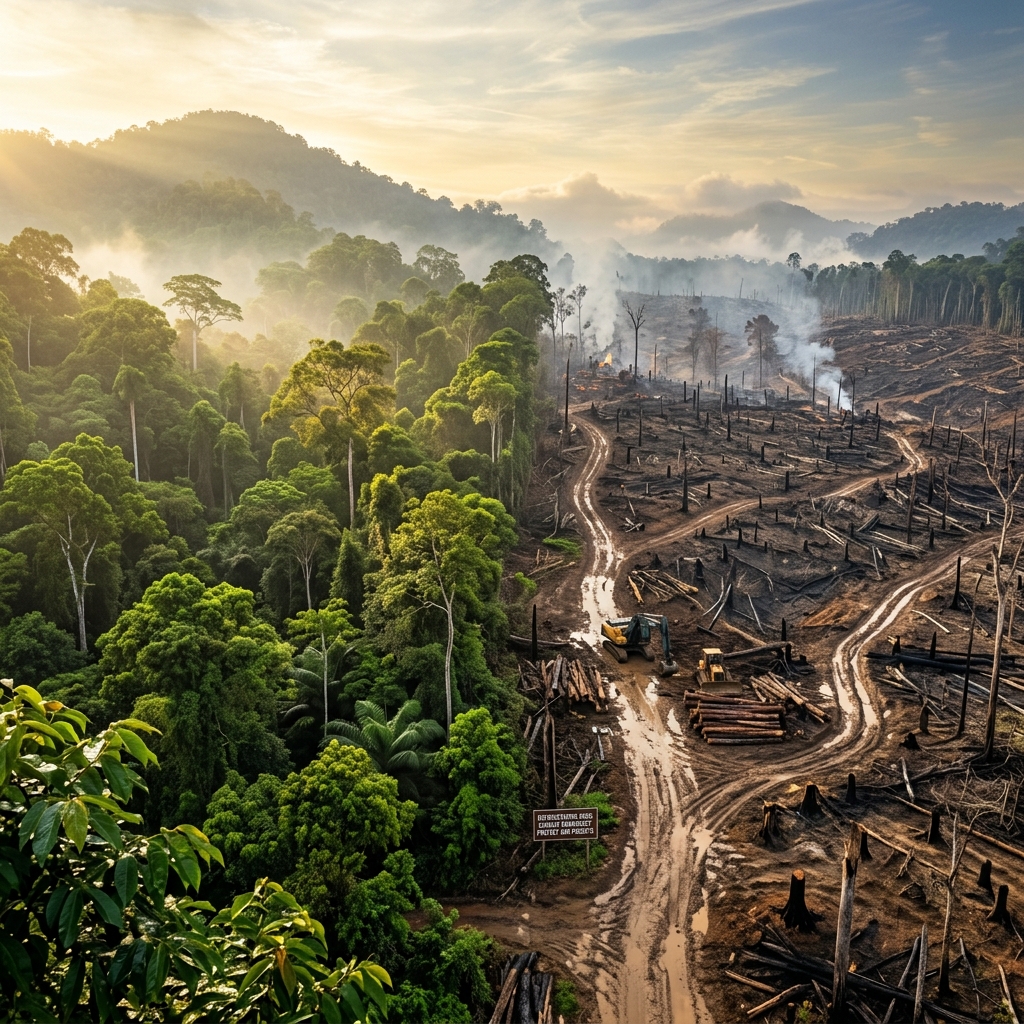
Here's something that should keep every corporate sustainability officer up at night: in 2024, the world lost 8.1 million hectares of forest. That's not a typo. That's the size of a small country — gone. Burned, bulldozed, cleared for cattle, palm oil, soy, and cheap timber. And according to the Forest Declaration Assessment, that rate of loss is 63% higher than the trajectory we need to be on to keep our 2030 promises.
We made those promises, by the way. More than 140 heads of government signed onto them at COP26. Leaders reaffirmed them again at COP30 in Belém just last year. And still the forests keep falling. Ten football fields of tropical primary forest every minute. All day. Every day.
The question isn't whether this is a crisis. It obviously is. The question is: who's actually going to do something about it?
The Corporate Accountability Gap Is Real — and Getting Harder to Hide
Let's be honest about what's happening in corporate boardrooms right now. Companies across the globe have made sweeping pledges about deforestation-free supply chains, net-zero targets, and responsible sourcing. The pledges are polished. The sustainability reports are beautifully designed. The press releases are immaculate.
The action, however, is a different story. In 2024, 150 major financial institutions directed nearly USD 9 trillion toward sectors associated with deforestation risk. Nine trillion dollars. Not divested from it — toward it. Meanwhile, the Forest Declaration Assessment found that financial flows to forests remain so far below what's needed that harmful subsidies outweigh green subsidies by more than 200 to 1.
A Ceres analysis found that dozens of the world's largest companies still lack comprehensive, time-bound, cross-commodity no-deforestation policies. Not obscure companies. Major brands. Household names that appear in your kitchen, your grocery cart, your retirement fund.
The Accountability Framework Initiative has been blunt: 2025 was a milestone year, with many companies having publicly committed to deforestation-free supply chains by that date. Most didn't make it. The expectation is now that companies will retain their 2025 target date in disclosures throughout 2026 while explaining how and when they plan to catch up. That's not accountability. That's a grace period for inaction.
The Science Is Damning — And Not Just for the Planet
We sometimes talk about deforestation as an environmental problem. But the science in 2026 paints a far more disturbing picture — one that touches public health, food security, and economic stability in ways that demand corporate attention for purely selfish reasons.
According to research published at the start of this year, tropical deforestation contributes to local warming that is linked to over 28,000 heat-related deaths annually. Separate analysis in Nature found that deforestation-driven erosion and chemical pollution contaminate soil, air, and water, contributing to an estimated 5.5 million cardiovascular deaths globally per year. Countries with larger forested areas show measurably lower rates of mental health disorders.
And then there's the economic argument. The Science Based Targets Initiative (SBTi) has calculated that deforestation and biodiversity loss could cost the global economy around $2.7 trillion per year by 2030. That's not a distant environmental externality. That's a balance sheet risk — one that ratings agencies and ESG frameworks are finally beginning to price in seriously.
What Real Progress Looks Like in 2026
There is genuine movement worth noting. The EU Deforestation Regulation (EUDR), despite experiencing some implementation delays, is beginning to function as a meaningful demand signal for deforestation-free commodities. By prohibiting the sale of products linked to forest loss, it's creating upstream accountability that voluntary commitments never could. As the World Economic Forum noted in February 2026, the EUDR is starting to act as a critically important driver for deforestation-free supply chains — if it holds.
The World Economic Forum has also launched the Forest Future Alliance, which aims to incentivize collective private sector and philanthropic action to conserve, restore, and steward forests. The SBTi published an updated version of its Forest, Land and Agriculture (FLAG) Guidance in March 2026, reinforcing that no-deforestation commitments must be embedded in corporate science-based targets — not treated as optional add-ons.
The Bottom Line: Finance Is the Deciding Factor
The uncomfortable truth of 2026 is that we have the science, we have the frameworks, we have the political declarations, and we even have a growing body of corporate commitment. What we don't have — at the scale required — is the money. Private finance that flows into verified, high-integrity forest protection and restoration. Capital that treats forests not as charity but as the high-returning, long-duration asset class they actually are.
The deforestation crisis is ultimately a capital allocation crisis. And fixing that requires the kind of corporate advisory infrastructure that translates ESG commitment into real investment portfolios — not reports, not pledges, not greenwashed press releases, but actual term sheets that deploy real money into real forests.
2026 is not the year to recycle last year's sustainability report. It's the year to either move from pilot to portfolio — or accept the consequences of continued inaction.
Sources:
- Forest Declaration Assessment 2025. forestdeclaration.org (October 2025)
- World Economic Forum: 'How Leaders Can Tackle Forest Finance in 2026' (February 2026)
- Preprints.org: 'Global Deforestation in Focus' — Peer Review Preprint (January 2026)
- SBTi FLAG Guidance Update (March 2026). sciencebasedtargets.org
- Ceres Deforestation Scorecard (2023). ceres.org
- Accountability Framework Initiative on Corporate Action, Ecosystem Marketplace (2025)